
Compressed Air Piping
REAL WORLD BEST PRACTICES |
|||
|
The subject of compressed air piping has probably had more pages written about it than any other topic, even storage. Like many other topics in “practical” compressed air technology, a significant portion of this is controversial and often directly opposed. These best practice guidelines are not designed to replace the appropriate correct volumes of information and are not designed to answer all questions regarding a specific installation. They are designed to arm you with basic principles that always apply and when followed, will end up with a well performing system. As with all our best practice guidelines, they are based on performance and measured critical data in the field molded with theoretical performance. We have developed and used these guidelines over the last 20 years and find them very accurate. |
|||
TYPES OF PIPING OFFERED FOR COMPRESSED AIR |
||||
|
Consult Federal, State and Local codes before deciding on the type of piping to be used. The usual standard to be applied to ANSI B31.1. For health care facilities, consult the current Standard NFPA 99 of the National Fire Protection Association. The compressed air piping materials can be divided into two basic types: Metal and Non-Metal. Non-Metal Pipe — commonly called "plastic" pipe, has been offered for many years as compressed air piping because:
What has held back this material’s acceptance by many compressed air people and organizations? Early on, PVC was used for compressed air piping. It was not long before the fact that it sometimes “shattered” and failed, sending sharp pieces throughout the area. This became evident. New products were introduced that utilized material that did not shatter. However, this material and all others offered to date have two significant limitations:
|
||||
TYPICAL PRESSURE TEMPERATURE RATINGS FOR THERMOPLASTIC PIPING |
||||
|
As with all other thermoplastic piping components, the maximum non-shock operating pressure is a function of temperature. The heat of compression should be fully dissipated so that the maximum temperature ratings (140°F for 1/2", 120°F for 3/4") are not exceeded in the pipe system. |
||||
Temperature (°F) |
Maximum Pressure Rating (PSI) |
|||
1/2" - 2" |
3" - 4" |
|||
|
100 |
185 |
185 |
||
|
105 |
185 |
172 |
||
|
110 |
185 |
160 |
||
|
115 |
171 |
147 |
||
|
120 |
157 |
135 |
||
|
125 |
143 |
Not Recommended |
||
|
130 |
128 |
Not Recommended |
||
|
135 |
114 |
Not Recommended |
||
|
140 |
100 |
Not Recommended |
||
|
The pressure ratings for typical thermoplastic piping and fittings are about a constant 185 PSI for all sizes in the temperature range -20°F to 100°F and are gradually reduced above 100°F as shown in the table above. Overall, the compressed air industry has not accepted any type of "plastic" pipe as appropriate and safe for down-stream compressed air. As a consultant, we would agree with this given today’s available material, data and available alternatives. |
||||
METAL PIPE |
||||
|
Metal pipe used for a compressed air system can be black iron, stainless steel, copper, aluminum, etc. with proper thermal/pressure characteristics. Black Iron or Steel Pipe — in compressed air systems will corrode when exposed to condensate (H2O) and thus become a major source of contamination to the whole system. This pipe usually has threaded connectiions when it is 3" diameter and smaller. It is typically welded if the diameter is larger than 3". Compared to copper and aluminum, it is much heavier and harder to work with, but less expensive. The internal corrosion issue is much more significant with oil- free air than with lubricated compressors. Stainless Steel — is often a good selection particularly when exposed to oil-free wet air and its extremely high acid level condensate (before the dryers). Stainless steel is often lighter for the same pressure temperature rating and installs well when welded. Threaded stainless steel often tends to leak. Ring seals such as those used in Victaulic connections will work well here. As piping material however, the potential lower installation cost and faster welding (use of Victaulic fittings) may well make it the most overall economical.
Copper Pipe — is a common selection for sensitive air systems. When selected and connected correctly it is very rugged. The working pressure of copper piping is 250 psi for Type “M” hard, Type “L” hard and Type “K” soft and 400 psi for Type “K” hard. Further, since 50/50 solder melts at 421°F, it will be more resistant to high temperatures. Even if it does fail, it will do so in a predictable manner. The pipe ends will separate. The working temperature limit of copper piping is about 400°F. (Data from Piping Handbook, 6th edition). Aluminum compressed air pipe as applied today has become very popular. This has been developed not only to provide smooth (low pressure loss due to friction) inner surface and eliminate "self contamination," but also to offer enhanced flexibility to meet the ever-changing compressed air distribution needs. This is particularly desirable in the automotive support industry with changing assembly and sub-assembly areas. Note: most aluminum pipe manufacturers rate their material at +4°F to 140°F or 176°F. The piping material usually has a melting point of over 1,100°F. |
||||
OTHER QUESTIONS ON MATERIAL AND OPTIMAL COATINGS FOR INLET AND DISCHARGE AIR PIPING |
||||||
|
The question of galvanized piping comes up often in compressed air system piping instead of schedule 40 black iron for the nominal 100 psig air systems. To help evaluate this, let’s look at inlet and discharge piping separately. General Guidelines for Inlet PipingThe proper inlet pipe brings the air from the filter to the compressor with no pressure loss, and should not create operational problems with any type of self-contamination on the inside. It is important to realize that the ambient inlet air condition may well dictate the selection of one type of pipe over another. Galvanized inlet piping has the advantage of resisting corrosion better than standard iron pipe. However, overtime when the corrosion does set in, the galvanizing material peels off. The inlet pipe is now a producer of potentially very damaging, solid contaminants between the filter and the compressor. This would be particularly dangerous to the mechanical integrity of a centrifugal compressor. We do not recommend this. During high-humidity weather it is quite conceivable that condensation will form in the inlet pipe (therefore, the OEM installation manual usually recommends a drain valve be installed on the pipe before the inlet). Condensation in the pipe will obviously accelerate the time frame before the coating breaks down. This time frame is dependent upon where the thinnest portion of the coating is applied. Stainless steel inlet pipe is an excellent material for such large-diameter, low-pressure inlet air, as long as it is installed properly and the inside is properly cleaned. There are also many grades of thermoplastic material suitable for inlet air piping. Extruded Aluminum - aluminum tubing that can be easily assembled with normal hand tools can bring a great deal of flexibility to an operating air system or sub-system. These are particularly effective for specific work areas, which may have to change on a routine basis. Summary: We recommend either stainless steel or proper thermoplastic-type material for inlet piping and do not recommend galvanized piping. Discharge and Distribution PipingHere we have more complex considerations: The discharge air from the compressors can be at 250 to 350°F (for centrifugal, oil-free rotary screw and reciprocating types), or from 200 to 220°F (for lubricant-cooled rotary screw compressors), so the pipe must be able to withstand those temperatures. Even if there is an aftercooler that drops the temperature to 100°F, consideration must be given to the consequences if the aftercooler were to fail. Compressed air-generated condensate tends to be acidic. In oil-free compressors (such as centrifugals and oil-free rotary screws), it is usually very aggressive. The basic objective of the interconnecting piping is to deliver the air to the filters and dryers and then to the production air system with little or no pressure loss, and certainly with little or no self-contamination. Galvanized piping will have the same problems once it begins to peel, as we described on the inlet application. In all probability, due to the aggressive acid characteristics of the condensate, the galvanized coating life may be much shorter. Regardless of the thermoplastic pipe manufactures claims; we never recommend any plastic type material for interconnecting piping and rarely for distribution header piping. Most of these materials carry cautions not to be exposed to temperatures over 200°F and to avoid any types of oil or lubricants. Here again, stainless steel is our number one recommendation for the interconnecting piping from the compressor to the filter/dryers when the compressed air is oil-free. It will obviously resist corrosion much better than standard schedule 40 black iron. Some other considerations: Most areas will allow schedule 10 stainless steel in lieu of schedule 40 black iron. For the same diameter pipe, stainless steel will be much lighter and easier to handle, usually lowering the labor cost. For welded connections, stainless steel usually just requires one bead, while black iron pipe usually requires three beads (Weld-fill-cover). This should also lower the labor cost. Stainless steel does not usually seal well when threaded. It will do much better with Victaulic type connections when welding is not practical. |
||||||
TYPICAL COMPRESSED AIR PIPE COMPARISON |
||||||
|
This comparison chart summarizes some of the pros and cons of each type of piping material. This information has come from discussions with piping manufacturers, mechanical contractors and plant personnel along with years of system analysis by airfield personnel. |
||||||
FEATURE |
BLACK IRON |
COPPER |
THERMOPLASTIC |
ALUMINUM |
STAINLESS STEEL |
|
|
Weight |
Schedule 40 Heavy |
Less Weight |
Lightweight |
Lightweight |
Lighter, Schedule 10 |
|
|
Corrosion Resistance |
No |
Yes, Proper Selection |
Yes |
Yes, Proper Selection |
Yes |
|
|
High Mechanical Strength |
Yes |
Less than black iron, but strong |
Low |
Less than black iron, but strong |
Yes |
|
|
High Temperature Capability |
Yes |
Yes |
No |
Yes |
Yes |
|
|
Ease of Installation |
Hard |
Less Hard |
Easy |
Easy |
Easy to less hard |
|
|
Installation Cost (Mtrl % / Labor %) |
25% / 75% |
40% / 60% |
50% / 50% |
80% / 20% |
30% / 70% (welded) 60% / 40% (victaulic) |
|
|
Type of Connection (varies with size) |
Flange / Threaded / Welded / Other |
Flange / Solder / Other |
Cold Glue / Sealed, Reusable |
Sealed / Reusable / Other |
Welded / Threaded / victaulic / Other |
|
|
Low "Friction-generated" Pressure Loss |
No |
Yes |
Yes |
Yes |
Yes |
|
|
Resistance to Deposit Build-up |
No |
Yes |
Yes |
Yes |
Yes |
|
|
Surface Treatment |
None (can be galvanized) |
N/A |
N/A |
Electrostatic coating |
N/A |
|
|
Melting Point |
Above 1,000°F |
50/50 solder limits to 400°F |
200°F to 450°F |
Above 1,000°F |
Above 1,000°F |
|
|
Ease of Modification After Initial Installation |
No |
No |
Yes |
Yes |
Welded: No Victaulic: Yes |
|
|
Special Tools Required for Installation (Welder, Pipe Threader, Groove Cutter, etc.) |
No |
No |
Yes |
Yes |
Welded: Yes Victaulic: Some |
|
|
Installation Requirements (Skilled Labor, Pipe Fitters, etc.) |
Yes |
Yes |
No |
No |
Welded: Yes Victaulic: No |
|
| Comparison made for standard 100 PSIG class compressed air system | ||||||
DISTRIBUTION HEADERS AND DROPS |
|
The objective for the main header is to transport the maximum anticipated flow to the production area and provide an acceptable supply volume for drops or feeder lines. Again, modern designs consider an acceptable header pressure loss to be 0 PSI. The objective for the drops and feeder lines is to deliver the maximum anticipated flow to the workstation, or process with minimum or no pressure loss. Again, the line size should be sized for near-zero loss. Of course, the controls, regulators, actuators and air motors at the workstation or process have requirements for minimum inlet pressure to be able to perform their functions. |
SPECIFIC TIPS ON PIPING — BY TYPE OF COMPRESSOR |
|||||
|
These tips are general in nature. For a specific unit, consult the manual and/or manufacturer. INLET AIR PIPINGRotary Compressors
Reciprocating Compressors
Centrifugal Compressors
DISCHARGE PIPINGRotary Compressors
Reciprocating Compressors
Centrifugal Compressors
|
INTERCONNECTING PIPING WITH MULTIPLE UNITS |
|
GOOD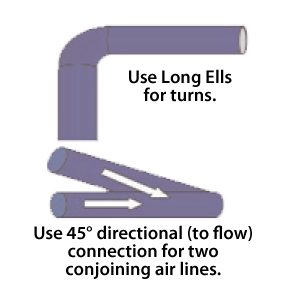 |
BAD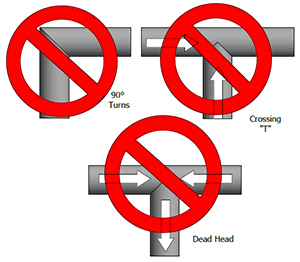 |
INTERCONNECTING PIPING CONFIGURATION |
|
|
Over the years, we have found very few plants where the interconnecting piping does not cause control problems with multiple units. This usually leads to multiple units at part load (poor basic efficiency), step controlled units with “extreme” short cycling, can have very poor efficiency and lead to premature failure of operating components. The objective in sizing interconnecting piping is to transport the maximum expected air flow from the compressor discharge through the dryers, filters and receivers to the main distribution header with minimum pressure drop. Contemporary designs that consider the true cost of compressed air target a total pressure drop of less than 3 psi. The interconnecting piping should be sized with regard to velocity rather than friction loss only; avoiding such things as high turbulence and its resistance to flow with resultant pressure spikes and loss. Design configuration has significant impact on this also. All pipeline velocities are to be 20 fps or less at 100 psig. At these velocities, even some poor piping configuration practices will have much less negative impact. |
|
GENERAL GUIDELINES - ALL PIPING |
|||||
|
All air (and water) inlet and discharge pipes to and from the inlet and discharge connection of the air compressor must take into account — vibration, pulsations, temperature exposure, maximum pressure exposed to, corrosion and chemical resistance, etc. In addition, lubricated compressors will always discharge some oil into the air stream, and compatibility of the discharge piping and other accessories (such as O-rings, seals, etc.) with both petroleum and/or synthetic lubricants is critical. |
GENERAL RULES FOR COMPRESSED AIR DISTRIBUTION SYSTEM |
|||||
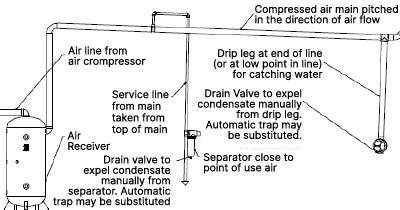 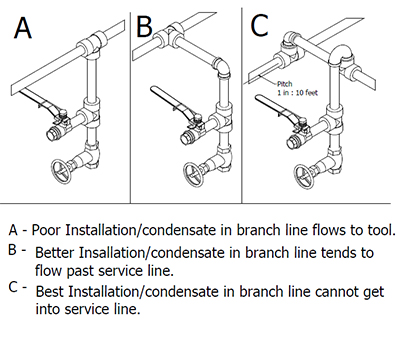 Flexible connections should be used to reduce or absorb vibration and mitigate the effect of thermal expansion. They Should Not Be Used To Correct Misalignments. Any Flex connection used should be investigated to be sure its specification fits the operating parameters of the system. It is important to note that improper or incorrectly applied piping and material in an AIR SYSTEM can result in Mechanical Failure; Damage; and Serious Injury or Death. |
SUMMARY |
|||||
Article by Hank Van Ormer Article Used with Permission of Compressed Air Best Practices Magazine. |